
RAF 113 SQUADRON
W/O BERNARD D. ALLEN
BACK TO W/O BERNARD D ALLEN listing || BACK TO SQUADRON PERSONNEL || HOME
Personal History of BD Allen for 113 Squadron Histories
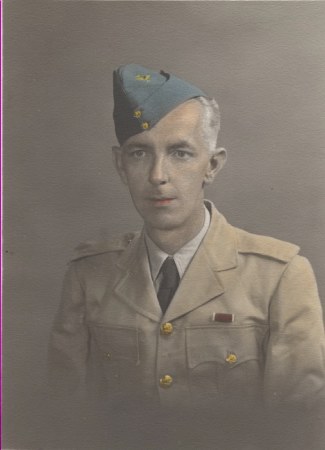
W/O Bernard Allen RAF - Heliopolis Egypt 1940
My father was born in Reading, Berks. on 27th February 1901; just too late to qualify as a Victorian, as the “old Queen” had died on 22nd January.
He applied to join the Royal Flying Corps on his sixteenth birthday, as a “boy entrant”, and reported to Cranwell Air Station on 14th December 1917. He was transferred to the RAF on its formation on 1st April 1918. His service number was 157641.
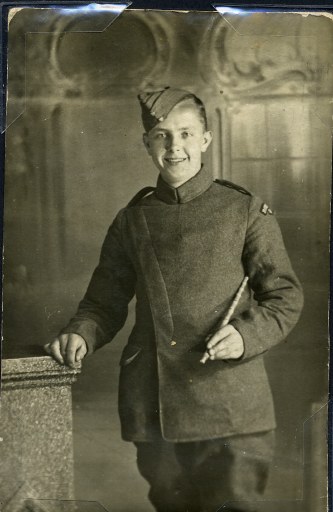
Bernard Allen Royal Flying Corps c1917
(Taken scarcely five years after the formation of the RFC, Bernard Allen is one of a very rare few who were there at the very dawn of aviation and serve through both World Wars.)
In these early days of the RAF the aircraft were all constructed of a wooden frame covered with doped fabric. Dad trained as a rigger, responsible for the maintenance of the airframe and the trim of the aircraft. The latter involved the alignment of the flying surfaces and the fuselage. As biplanes were the order of the day a lot of this alignment was done by the correct tensioning of the flying wires between the wings.
I have very little information about his first six years in the RAF but I have been able to deduce that he was overseas for some of that time. During this period the RAF kept most of it’s operational squadrons in active service in the British Imperial and mandated territories, including Mesopotamia (Iraq), Aden and India. They successfully introduced the policing of remote and primitive areas from the air. In India this often consisted of first sending a plane over a village, warning the inhabitants to leave as it was going to be bombed. It usually took only a few small bombs to produce results that the army had been unable to achieve with their slow and cumbersome columns. Some other countries required more drastic measures.
N.B. In this document ‘India’ refers to British India; it being long before partition resulted in the formation of Pakistan and India as separate states in 1947.
My father developed a keen interest in photography, with particular interest in native peoples and customs. At least two street photographs are labelled as being taken in Baghdad, thus clueing me into the probability of a Mesopotamia posting. I know for sure that he was in Aden and India.
Dad was back in England in 1924, a corporal and stationed with 39 squadron at Spitalgate aerodrome, which was on top of a large hill outside Grantham. The squadron was equipped with DH9A’s.After experiencing life overseas he and his friend found the peacetime pace in England somewhat boring, so they volunteered to go overseas again. This was a mistake because on one evening in 1926 he met my mother.
At this time RAF personnel were required to carry a “swagger” stick under their arm when they were walking in public. They were also not allowed to carry parcels, so ladies had to carry their own shopping home.
Later that year his posting to India came through. Mum wanted to get engaged before he went, but Dad had seen too many men get “Dear John” letters and wouldn’t do it. An overseas posting at that time meant a total separation from the UK for up to four years. There was no private communication by telephone and it might take two months to get an answer to a letter. Really bad news traveled faster, by telegraph. No one wanted to get a telegram. Dad said that if Mum still felt the same way about things when he came home they would get married and this they did.
I don’t know where he was in India at Xmas that year but he was at Risalpur for Xmas 1927.
The spelling of Miranshah is taken from an official RAF photograph of C flight taken in 1929. It was also used on that flight’s Christmas Day Menu in1928. It is interesting to note that an article in The Economist in March 2006 uses the spelling Miran Shah and describes it as the capital of the North Waziristan tribal area.
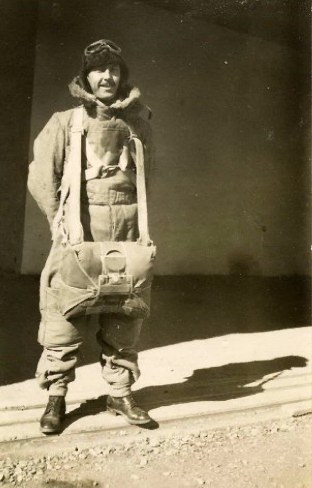 While he was at Miranshah he was involved in parachute development work. Parachutes were still in their infancy at the time and I assume that the work involved testing new designs or safety features.
 The program sometimes required the use of a mannequin fully dressed in RAF flying gear. The test dummy would be would be fastened to an aircraft’s fuselage, taken up and released with some form of ripcord that would open it when it was safely clear of the plane. On one occasion the parachute didn’t open and the dummy fell to earth. It landed in the middle of an Indian village. When a ground crew arrived to pick it up it was lying in the middle of an open square, watched at a distance by the village’s entire inhabitants, who were somewhat taken aback at the event. They received an even bigger shock when two of the callous British took the “body” by the head and feet and tossed it into the back of the tender.
The photograph to the left, taken at Miranshaw 1929 shows Dad in full flying gear but I am sure that he never actually jumped. The photo immediately below shows men hanging onto the wing struts of a twin engine Vickers Virginia biplane bomber in flight, pulling the ripcord of their parachutes and being pulled off the wings as they opened. These aircraft trundled along at less than 100 mph but it must have been quite an experience.
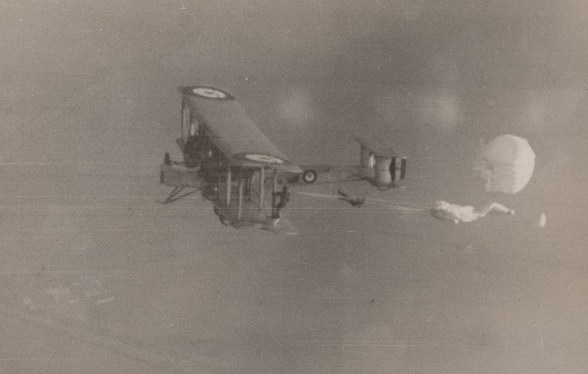
Parachuting from Vickers Virginia
A very rare and simply amazing photograph, note buildings (possibly aerodrome) bottom left.
Source/copyright: collection of F/Sgt (W/O) Bernard (Dick) Allen, son John Allen
Miranshah was the smallest and most remote RAF station in India. It was situated in the North West Frontier Province about seven miles from the border of Afghanistan. This was Pathan country, described in ‘History of the RAF’ as “27,000 square miles of wild un-administered country” (70,000 square kilometres) containing “the largest tribal population in the world, estimated to number 10 million and including some of the world’s finest and most merciless fighting men”. They were constantly in revolt and always a threat.
Aircraftsman Shaw, previously known as “Lawrence of Arabia” was stationed at Miranshah from June to December 1928. He had clashed with his previous C.O. and asked for a posting. The RAF was forced to send him back to England when the press discovered him in this most sensitive area. Dad photographed him while he was there.
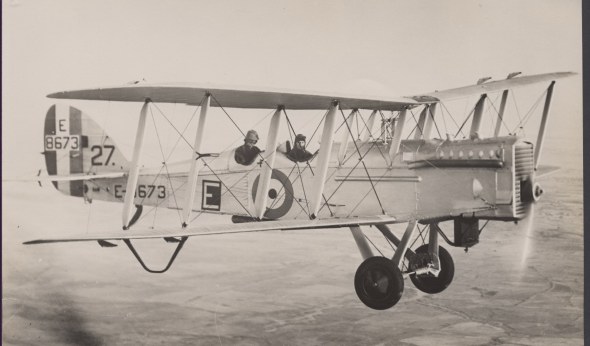
De Haviland DH9A from Miranshah
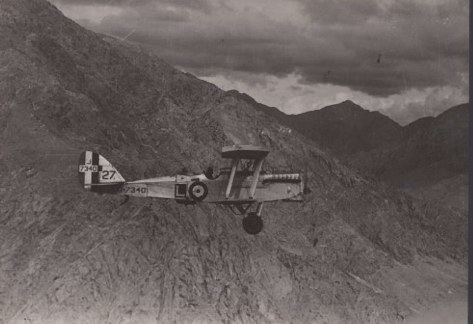
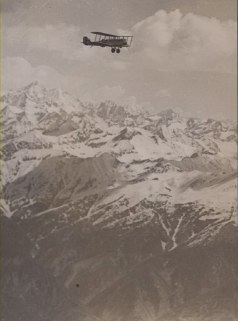
(The three flawless photographs grouped above and below are all of the DeHaviland DH9A, crews & squadron unknown. Unquestionably the bottom right photo was taken over the Himalayas. With virtually no place to land and no radios, flying these old unreliable aircraft over such desolate and remote terrain took considerable courage). DH9A's performance was severely restricted in the high mountain air despite the fact it supposedly had a service ceiling of 15,000 to 18,000 feet fully loaded. The typical bomb load was 20lb Cooper bombs. Source/copyright: collection of F/Sgt (W/O) Bernard (Dick) Allen, son John Allen
Returning to England early in 1929 he married my mother in March. He was posted to Henlow, Bedfordshire, and signed on for another 12 years. He wasn’t there very long as February 1930 found him on the SS City of Exeter, on his way to Aden.
I have been puzzled at the short span of time between overseas assignments; it doesn’t seem to fit the normal practice. I attribute it to maybe being due to one of two causes.
a) Perhaps because his last posting had been a voluntary one and wasn’t included in the normal rotation.
b) His remustering constituted a new contract and so the previous posting was not a factor. This could also have been exacerbated by the fact that most of the RAF active squadrons were abroad at the time.
Just across the Gulph of Aden, where the Red Sea meets the Indian Ocean, on the Horn of Africa, is the Somali Republic (this status is in flux at the time of writing). In 1920 it was a British Mandate under the auspices of The League of Nations and was the scene of a mini-war against the Mad Mullah, Mohammed bin Abdullah Hassan. He had been a thorn in the British side for 20 years and successive efforts by the army had been unable to eliminate him.
The RAF led a successful campaign which achieved this goal in a matter of weeks, and in doing so won its fight for institutional existence.
In the period 1930-33 the RAF was again in British Somaliland, and completed an aerial survey of 30,000 square miles (77,700 square kilometres or hectares) of its territory. It is probable that, the early stages of this activity were conducted by aircraft temporarily detached from Aden.
Dad’s collection of photographs includes one of a tented camp at Buramo, with a notation that it was an Air Survey Flight in British Somaliland. His involvement must have been brief because he was promoted to sergeant about 30 th November 1931 and was in Aden for the Xmas dinner. An official group photograph, dated 1st January 1932, shows him at his new posting in Ambala, in the Punjab, India.
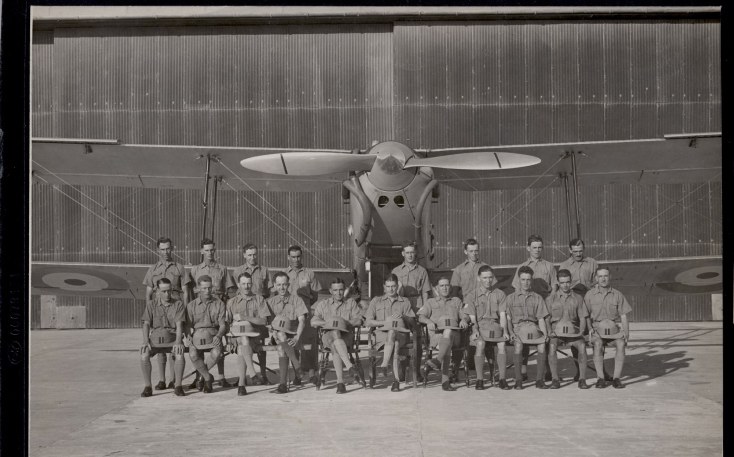
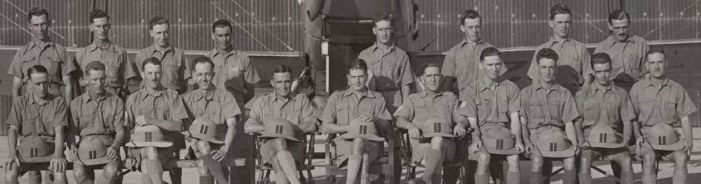
Squadron ?, C flight, Aden, 1931
Corporal Allen fourth from left, seated.
Source/copyright: collection of F/Sgt (W/O) Bernard (Dick) Allen, son John Allen
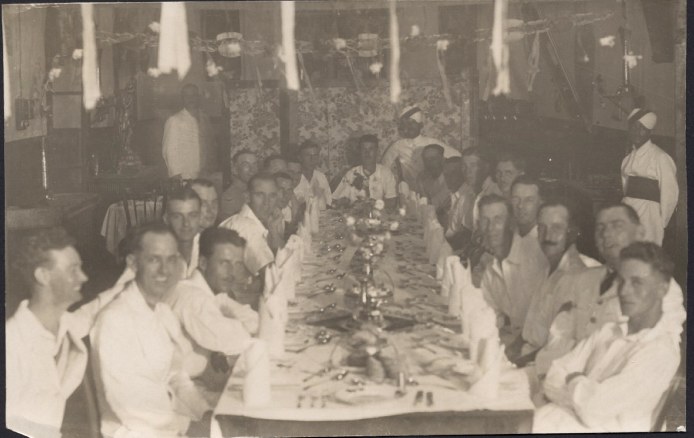
Corporals Mess ADEN, 21 November 1931 (21/11/1931).
Farewell dinner for new sergeant (left front,seated). Note some
of these chaps are in photo above. Note also the crossed cutlery,
all in all a beautifully set table, complete with servants standing by.
Source/copyright: collection of F/Sgt (W/O) Bernard (Dick) Allen, son John Allen
My mother and I joined him later in the year. We traveled on the HMT Somersetshire from Southampton to Karachi via Basra. Mum had never traveled alone before and certainly had never gone very far from home in her life, so it took a lot of courage to make this journey with a small child.
The souvenir log shows that the voyage took 30 days, from 4th October to 3rd November. Commercial liners must have been much faster than this, possibly cutting off as much as a week on the journey. The log also shows that at 6.02 pm on 19 th October we passed the HMT Nevasa in the Red Sea on its return journey to England. In September 1938 the same Nevasa was to take Mum and I to Egypt to join Dad there. The troops on both ships would have been told of the impending encounter and the Captains would have passed close to each other. It was traditional on these occasions for the returning troops to jeer at the “unfortunates” on the way out.
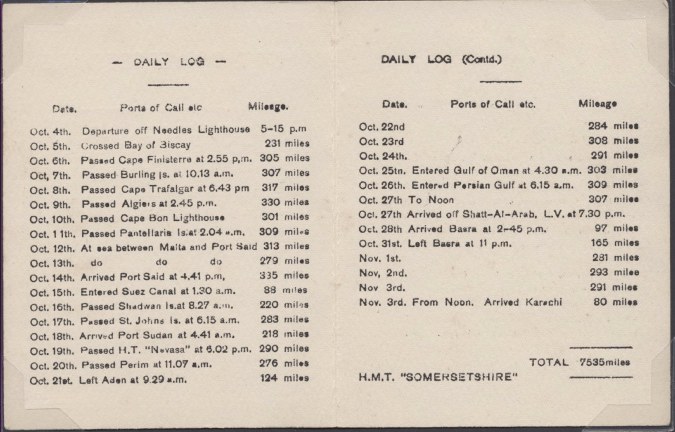
Souvenir Log card from HMT Somersetshire
Source/copyright: collection of F/Sgt (W/O) Bernard (Dick) Allen, son John Allen
The Somersetshire was on a bit of a milk run and dropped people off at Aden. It then passed around the bottom of the Arabian Peninsula and traveled up through the Persian Gulf to do the same thing at Basra in Iraq. She would probably have embarked people there who were traveling back to the UK. The troopships only kept this particular schedule in the winter months, with families on board, as there was no such thing as air conditioning and it would have been too hot for them in the summer. An attempt was made to cool the outside cabins by fitting air scoops on the portholes. This was a help as long as the ship was moving.
The term “posh” was derived from the more well-to-do folks, traveling on regular vessels, reserving port side cabins on the outward journey to India and starboard side ones for the voyage home, (thus avoiding some of the effects of the afternoon sun and traveling POSH)
We had a bungalow on the aerodrome in the winter months and spent the summer at the RAF hill station at Lower Topa in the Murree hills. We sailed for England on 11th November 1934.
The first posting in England was to North Weald in Wiltshire. November 1936 found him at Thornaby in Durham, where we again lived in married quarters. This was followed by a short spell at Hullavington where he was promoted to Flight Sergeant.
In 1934 the British government proposed the completion of a long-delayed expansion of the Home Defence Air Forces to 52 squadrons, with an additional 23 to follow, half of these were to be bombers. Progress was slow and the reforming of 113 squadron at Spitalgate, Grantham, on 4 August 1937 was probably a part of the program.
Dad was posted to the squadron at that time. In due course we moved in to the married quarters, which were situated on the crest of the hill, with a great view toward the town.
113 squadron was posted to Egypt in April 1938 and arrived at Heliopolis on 10th May. They traveled on HMT Lancashire. The squadron was equipped with Hawker Hind light bombers. At the time of their introduction to squadron service in 1935 they were faster than the contemporary fighters, but in 1938 they were being phased out. This was possibly a reason that they were being moved to a less demanding theatre of operations.
The Hinds did not have the range to fly out to Egypt in a satisfactory manner so they were dismantled, crated and shipped by sea. Dad was in command of the rigging of ‘A’ flight aircraft (you could tell them in flight by their red wheels and spinners) and, up to that time, each one had been treated like a prima donna, with each being rigged a little differently in an attempt to tune it for maximum performance. It was felt that this had got out of hand and the decision was made that when the aircraft were reassembled in Egypt they were all to be returned to a standard rigging. This proved to be successful and simplified ongoing maintenance.
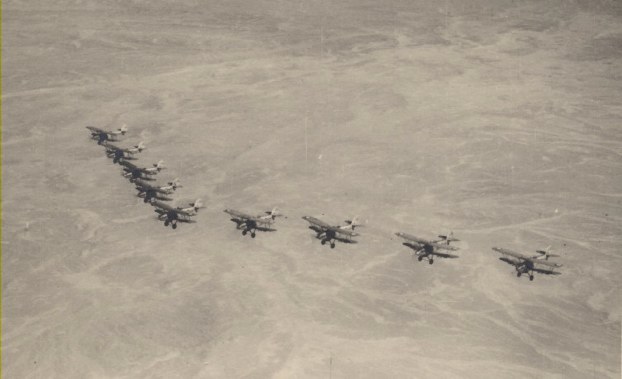
113 SQUADRON HIND'S OVER EGYPT
Source/copyright: collection of F/Sgt (W/O) Bernard (Dick) Allen, son John Allen
(Note that the Hind's now have bomb racks fitted to the wings which can be seen just under the wing leading edge)
NOTE: Martin Carter, (F/Lt) Bill Whittlesey has this identical photo in his
collection titled: Not all the desert is flat, a snap from 3000ft.
(Note: See photo section for other Formation shots of F/Sgt (W/O) Allen)
Source/copyright: collection of F/Sgt (W/O) Bernard (Dick) Allen, son John Allen
On 2 nd September Mum and I embarked on HMT Nevassa in order to join Dad. The ship called at Gibraltar, Malta and Jaffa before arriving in Alexandria.
As soon as we arrived mum was issued with a British Forces Identification Card. This stated that she was “a member of the British Forces in Egypt” and had “Immunity from the jurisdiction of the Egyptian Courts”. This did not give her immunity against the Egyptian laws but ensured that she could only be dealt with by “Appropriate British Courts”; an essential condition. I don’t know if this document was ready and waiting for her signature or if it was the subject of priority as soon as we arrived. The issuing stamp seems to be for the 31 st of the month (see below).
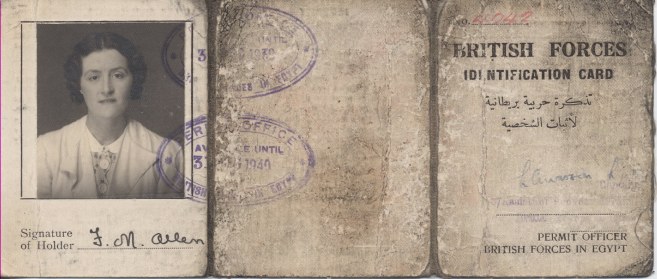
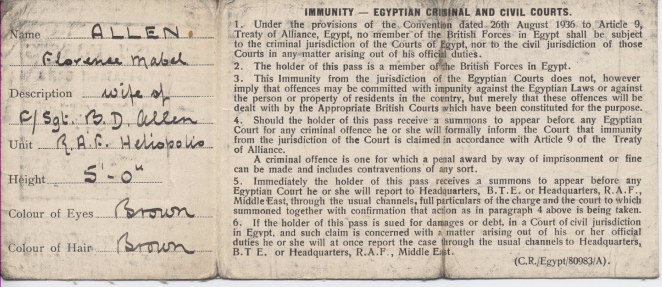
Source/copyright: collection of F/Sgt (W/O) Bernard (Dick) Allen, son John Allen
Another major item was considered to be the immediate purchase of Topees, considered to absolutely necessary for the posting at that time.
For about the first year we lived in a flat on Rue Hippodrome, overlooking the racecourse. The block of flats was arranged around a small central well leading off the kitchen. A metal staircase wound up the well and each flat kept a garbage can on the landing outside the door. On one occasion Mum was putting some garbage out when a young Egyptian threw a brick at her from the roof a couple of levels up. It missed and hit the landing beside her. Dad ran up to the roof and caught the fellow. He was unable to exact any corporal punishment himself as the consequences would have been disastrous. Instead he took him down into the street and turned him over to his master, who was able to administer punishment.
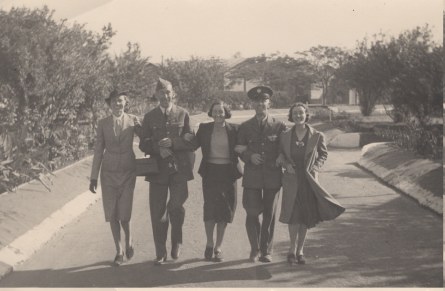
Christmas day 1938
"Lofty" Leach and wife - left, wife of the photographer -centre, F/Sgt Dick Allen and wife Florence.
They are walking down the main road in the camp after visits to (I believe) other units for a drink.
Source/copyright: collection of F/Sgt (W/O) Bernard (Dick) Allen, son John Allen
113 squadron was tasked with a photographic survey of the area adjacent to the Libyan border. The squadron’s Hawker Hinds had a very limited range. One source that I have tapped suggests a 3 hour duration at 170 mph, while another shows a range of 430 miles. It was insufficient to let them do the job from Heliopolis so on the 28 th September they moved to Mersah Matruh, approximately 270 miles (430 km) west, a forward airfield on the coast and close to Libya. The squadron history shows that they were not to return until May 1939.
The living conditions were primitive and the only recreation was swimming in the Mediterranean. It would seem that King Farouk had a place nearby and one day he approached the swimmers and ordered them out of Egypt. The service wives sent food parcels by returning squadron aircraft as often as they could. Mum’s specialty was mince pies.
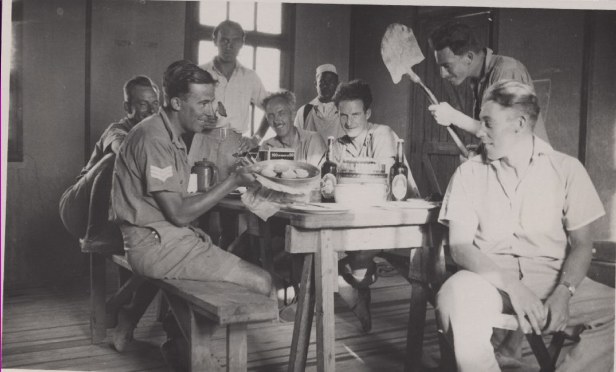
Defending the mince pies from the flies – Mersah Matruh
F/Sgt (W/O) Allen fourth from right sitting, others unknown
Source/copyright: collection of F/Sgt (W/O) Bernard (Dick) Allen, son John Allen
During this period Mum was living alone with me at the flat. Sometimes she would wake up in the night, thinking that she had heard a noise. She would get out of bed and slowly make her way through the flat, turning on the lights as she went. When she was satisfied that there was no intruder she would reverse the procedure. Under the circumstances, this took a lot of courage.
A vacancy in the married quarters came up and we moved on to the aerodrome.113‘s hangars weren’t very far up the road. Across the aerodrome was 216 squadron. It was dedicated to troop carrying and, during the early days of the war, night bombing. It was equipped with lumbering twin engined biplane Vickers Valentias and equally poor performing Bristol Bombays. As I recall, behind the 113 hangars was 208 squadron, which had at least one Lysander. (In March 1939 S/Ldr Cator , the C/O of 113 Squadron, was replaced by S/Ldr Keily who came from 216 Squadron and was well know for his ability on the Valentia's.)
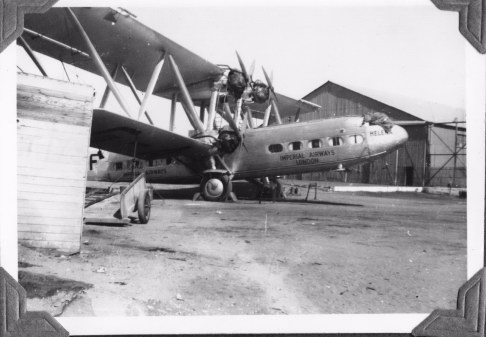 On one occasion, for some reason a large four engined biplane stopped at the station overnight. It was so big that only the front of the fuselage and the engines could get into the 208 hanger. The internet tells me that it was most likely a Handley Page 42 Hannibal from Imperial Airways time.
(Photo Source and Copyright: Corp Stan Harrison. Titled "An Old Soldier." This was one of only four in the Middle East in 1939 and all were impressed into service with 271 Squadron untill 1940. A total of eight H.P.42/45 aircraft were built, four of each type and all were named, with names beginning with the letter "H". This one at Heliopolis was Helena as can be seen on the nose.
113 squadron hangers were situated in a row at right angles to the main road that ran through the camp. “A” flight was closest to the road. The flight’s Squadron leader was a 26 year old RN Bateson. Later, on 11th April 1944, as a Wing Commander, he was to earn The Distinguished Service Order (DSO) for leading the famous low level daylight mosquito raid that destroyed the Gestapo headquarters in the middle of The Hague.
In 1939, when he returned from a flight, he used to dive bomb the flight offices. The Hind was not designed to be a dive bomber and staggered through the air at the bottom of the dive as it was pulled out into a climb. Dad used to remonstrate with Bateson over this practise, who in turn replied that it was all right because he was up there and didn’t want to crash. Dad used to reply that it might be all right for him but that he was underneath and didn’t like it.
Sometimes Bateson would return from a flight on a Sunday afternoon. Dad would, of course, know the schedule. Bateson would fly low over our house before circling to land. Dad would promptly put me on the crossbar of his bike and ride up to the hangar to meet him. I would climb into the plane while they opened the hangar door, and sit there in grand style as it was pushed inside.
Sometimes members of the squadron would fly to Jaffa in Palestine. If they were in season they would load up the planes with sacks of Jaffa oranges for the return trip.
In 1939 the squadron was re-equipped with the Bristol Blenheim Mk I. Pilots were sent to England to fly them back to Egypt. The whole of the camp knew when they were due to arrive and when the time came on 12 th June everyone lined the road to watch them come in. The landing went off well, but as they taxied in front of the spectators, the lead plane, with its engines still running, gracefully settled onto the ground. The crew jumped out and the crash wagons rushed up. Apparently the undercarriage had failed to lock down.
There were regular dances at the Sergeant’s Mess and they were very lively affairs.
On 9 th September 1939 our family was at an outdoor cinema in the city when, in the middle of the performance, the air raid sirens sounded. All the lights went out. It was a false alarm but we lost no time in returning to the camp.
About this time Dad was offered a commission but he declined to accept it.
The station built a small gas proof structure just behind the married quarters. We were all fitted with gas masks and had to test them by going into the building for a time, when it was filled with tear gas.
At Xmas 1939 the camp school put on a concert in one of 216 squadrons hangars. It was only supposed to be a parent occasion but the camp asked if we would do a second performance for all personnel. We played to a packed house.
The decision was made to move all of the families out of the camp in case it came under attack. The RAF took over a street in the city called Rue Gabaris and each family was allotted a flat. They were furnished, and our personal belongings were delivered to us. One flat was designated as a school, run by the teachers from the camp school.
In March 1940 the squadron was re equipped with Blenheim Mk IV’s. From visits to the hangars, some not authorized but supervised by the men who knew me, I was reasonably familiar with the inside of the earlier machines but I don’t recall ever being in one of the new ones.
In July 1940 the families were evacuated to Palestine for greater safety. Mum and I were allowed to take clothes and personal effects but that was all. The RAF put a wooden crate outside the door of each flat and we were told that it could be filled with our belongings and that it would then be placed in safe storage for an undeterminable length of time. All the rest of our possessions were to be disposed of. The local Egyptians soon became aware of the situation and gathered on our doorsteps like vultures to pick up bargains. Our position was hopeless of course as the day of departure was set and everything had to go by then.
We were put on a special train at Cairo – destination Jerusalem. The Suez Canal was crossed by ferry at al-Qantara and a second train took us the rest of the way. The RAF families involved were quartered in The Austrian Hospice, in the Muslim quarter of the old city. The view from our room looked out over the roofs of the old city to the nearby Dome of the Rock on Temple Mount.
The RAF set up a school for us in the YMCA in New Jerusalem (It was later blown up by a Zionist terror gang circa 1947). To reach it we walked up Al Wad street and out through the Damascus Gate, from where we were bused to school.
The squadron must have been in the Western Desert by this time but Dad managed to spend a leave with us before we were again on our way to Margate in South Africa, in September. This time we reversed the rail journey but went on to Suez. The RAF families were on the 40,000 ton SS Empress of Canada and the army families were on the SS Empress of Britain. The two ships, which were famous before the war as the CP White Empresses, were the centre of a fast convoy.
As the 113 squadron ground crews were heading west into the desert they were met by Egyptian army vehicles going the other way as fast as they could. When they managed to stop one to ask what had happened, they were told that they were going back to defend Cairo.
Dad was promoted to Warrant Officer.
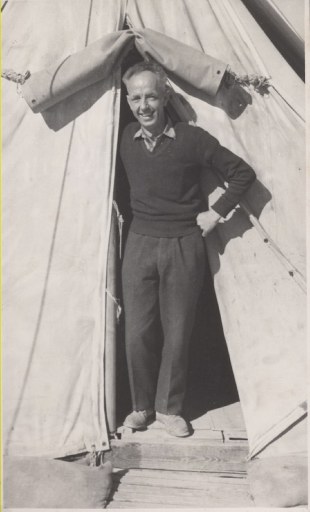
W/O Dick Allen - Home in the Western Desert
Source/copyright: collection of F/Sgt (W/O) Bernard (Dick) Allen, son John Allen
My father was a part of the squadron at Niamata on the infamous 15 th April 1941. His impression was that the first orders were to load the lorries with spare parts and send them to the rear and then return for the personnel. This was subsequently changed to putting people first. When they reached the port of embarkation there was an ammunition ship on fire. It was so impressive that a lot of the airmen decided to stay on deck all the way to Crete.
I don’t know how much of the squadron ended up at a small landing field in the hilly interior of Crete, but A Flight certainly did. They hid in the woods surrounding the field and were advised that rescue aircraft would take them off in due course. Because of the Germans overwhelming air superiority the aircraft had to minimize the time that they spent on the ground. They would turn around at the end of their landing run and immediately begin the takeoff run. The men were told which aircraft they were programmed to board. They were to run to intersect it as it made its turn for the takeoff and scramble aboard as fast as possible.
When it was ‘A’ flight’s turn all went well except that, because of his age, Dad couldn’t run as fast as the others. The pilot wanted to go and shouted for the door to be closed, but the men wouldn’t do it. They hung out of the door and urged him on. When he managed to get close enough they dragged him in, closed the door, and they were off. Being the senior man to board he went up to the flight deck to speak to the pilot. He said “I wouldn’t want to be you going back there again” The pilot replied “We aren’t, this is the last plane out”.
Back in South Africa Mum was desperately waiting for news. The wives around her were receiving telegrams advising them of their husband’s safety but none came for her. At the very last her turn came.
Dad obviously had some leave in Tel Aviv as the following photograph shows him enjoying a well earned beer there, in the company of someone who is unknown to me. A further photograph shows him on the way to Ramleh, where the squadron was re- equipped. I don’t know if he accompanied the squadron back to the desert but would presume that he did.
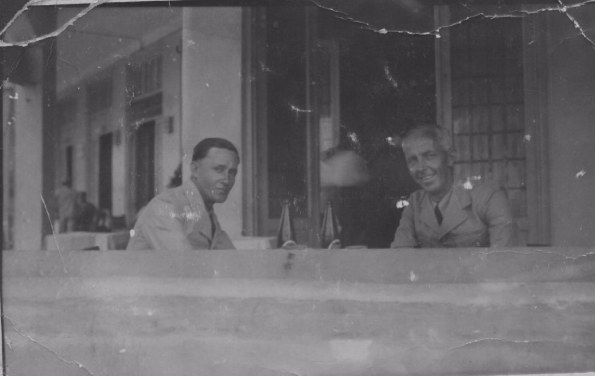
A cold beer in Tel Aviv
W/O Dick Allen on right, other unknown
Source/copyright: collection of F/Sgt (W/O) Bernard (Dick) Allen, son John Allen
On The Train To Ramleh !
Sgt Ewan Brooking far right, W/O Bernard (Dick) Allen center, left unknown.
Source Sgt Ewan Brooking
Following the disaster in Greece the squadron was reformed at Ramleh Palestine and subsequently returned to the desert. In November 1941 the squadron was once again recalled and were sent off to Burma. It is assumed that W/O Allen posted out of the squadron at this time as did many others.
One of the RAF’s major tasks at the time was to rebuild the desert air force. A part of this effort was the importation of American Tomahawk and Kittihawk fighters. They arrived in crates and had to be reassembled and then modified for desert warfare. Dad was posted to the base in the Canal Zone where this activity took place and put in charge of the day-to-day operations.
The RAF men worked tremendously long hours, seven day’s a week. They were assisted by American civilians from the manufacturers. These men were equipped with wonderful tool kits and specialised tools. The USA wasn’t in the war at this juncture and they weren’t as motivated as the British servicemen and could not be induced to pitch in. As one of them said to Dad as he sat against a wall and watched the RAF fitters working. “I’m a tail wheel specialist”; and that is all that he did. At one conference, when Dad was asked if anything could be done to speed up the work, he said “keep the tool kits and send the Americans home”.
Early in 1942 Dad was posted home, thus completing his last overseas posting. He was given the option of leaving his family safe in South Africa for the duration, or picking us up on the way. We had always been a close knit family and he chose the latter. I don’t know if there was time for Mum to be consulted, but if she was she would certainly have concurred. Dad was able to spend quite a bit of time with us at our hotel while we were waiting for passage home.
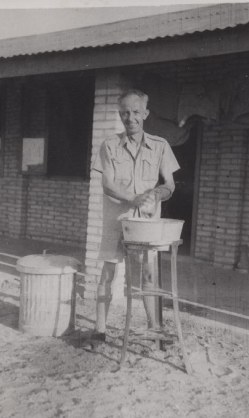
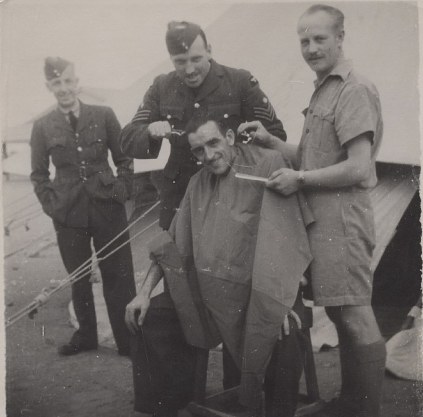
Transit Camp Suez 1942.
Note that W/O Allen has no stripes, but badges on the outside of each sleeve just below the elbows.
Source/copyright: collection of F/Sgt (W/O) Bernard (Dick) Allen, son John Allen
In a remarkable piece of management for the times, the RAF had arranged for the wood crate that had been packed with our belongings in Heliopolis, to accompany us to Margate. It was stored in the basement of a hotel where Mum could check on it from time to time. Even more remarkably, it arrived at our final destination at my aunt’s house in Grantham within weeks of our arrival. It was too big to take into the house so it was placed in the back yard. When it was opened, almost exactly two years after it was packed, it released a number of moths, who had spent an adventurous journey devouring our belongings. In later years whenever my aunt discovered a moth in the house she would denounce it as “one of those damned Egyptian moths”.
The significant events of our journey home are clear in my memory. The actual dates are not; for these I have consulted the Cruise Diary that I kept. At the time I was advised by my dad to show some restraint in detailing anything that might cause problems if it ended up in the wrong hands. Partly as a result of this there is some confusion concerning actual dates. What follows is my best reconstruction of the voyage.
We began our journey home on the 22,000 ton Canadian Pacific liner SS Duchess of Bedford, sailing from Durban on 25th May 1942. She had of course been taken over for wartime service as a troopship and fitted with some defensive armament. She had a bad reputation for being very lively in any sort of sea condition and was dubbed “The Drunken Duchess”. We ran into a violent storm all the way to Capetown and she lived up to her name. I believe that we arrived at Capetown about 4pm on 31st May.
Three days later, on the 1st June we were told that the ship’s orders had been changed and that we had to take our personal baggage ashore with us and disappear into the city for the day. When we returned in the evening she had gone and a New Zealand hospital ship Orangi had taken her place. We were given sparse accommodation on board and it was our home for 4 or 5 days. One evening we came back to the dock to find the SS Duchess of Atholl waiting for us. She was a sister ship of the Bedford. We were assigned a cabin on the boat deck, alongside those of the ship’s officers.
I believe that we sailed for the UK at 1400 h on the 6th June (the diary states that we were “at sea” on the 7th). The Captain had elected to decline passage in a convoy and we sailed alone relying on speed and a good lookout to keep us safe. The method was for the vessel to sail in an almost random zigzag pattern during daylight hours and to straighten out and travel at high speed after dark. I don’t recall if we did this when we left Capetown but we certainly did after Freetown.
The lifeboats were kept slung out at the Promenade Deck level, to speed any possible need to abandon the ship in a hurry. Passengers were required to carry their lifebelts at all times. Every day except Sunday there was lifeboat drill at 4pm. The diary shows that on the 8th June we also had “action stations” and “abandon ship” drills, but I don’t recall any details.
We crossed the equator on the 10th but there were no ceremonies to mark the occasion.
On the 13th, after 7 or 8 days at sea, we arrived at Freetown, Sierra Leone. This was an important base for the Royal Navy, guarded by anti-torpedo nets and patrols. After waiting outside the harbour for two hours we entered at 1600h and dropped anchor in the roads. We stayed there for three days and no one was allowed ashore.
While we were there a convoy sailed. This was quite a spectacle as it was preceded by escort vessels passing through the boom and dropping patterns of depth charges to discourage any possible U-boat ambush. There were a number of major naval ships anchored nearby and at noon on 15th a battleship and escort came in. My diary incorrectly names it as being HMS Hood but this is not possible as she was sunk on 24th May 1941. She was a most recognizable ship and my memory favours either the Nelson or the Rodney.
Boat drills resumed on the 15th and the next morning an oil tanker came alongside and refueled us. We sailed for the UK at 17.50hrs.
Our course took us well west into the South Atlantic and then north, to eventually swing down south of Iceland and into Glasgow. On the 21st we entered the Sargasso Sea, where early mariners thought that old ships lay trapped by seaweed.
The 24th was a beautiful sunny day with a calm sea. We were proceeding at a good pace when suddenly the ship heeled over and made an emergency 180 degree turn, followed by a maximum increase in speed. The upper works of a vessel came into view over the horizon speedily overhauling us. A signal light flashed from its bridge and we slowed down and resumed our course. It turned out to be the leading destroyer escort of a large convoy, which we passed on our starboard side. I record that in the evening Mum and Dad went to a “crazy night”, followed by a note the next day in my record that says that they had “quite recovered”.
The last entry in the diary is for the 26th and 27th and merely states “nothing doing”. However this was not the end of the voyage as things got tenser as we entered the area of maximum danger. Each family had been told that in the event of having to abandon ship they would only be allowed to take one small bag into the lifeboat. This was to carry emergency supplies. Mum prepared ours and kept it with her at all times. We also kept fairly close to each other during the last three days and we were told to sleep fully dressed in case of attack. I believe that we arrived at Glasgow about 1st July, 36 days after leaving Durban.
Just two months later, the Duchess of Athol was torpedoed in the middle of the South Atlantic at 6am on 10th October 1942, while repeating the same trip. She took three hours to sink and there was very little loss of life. The U-boat surfaced near the lifeboats and the captain apologised for the sinking. He also told them to stay together as he had radioed their position. After three days a destroyer approached. She took her time in ascertaining that the U-boat wasn’t still around and then closed with the boats and rescued the survivors. By this time most of them were in pretty bad shape and had to be helped aboard. They were later transferred to another British ship and taken to the UK.
We eventually ended up in a deserted station at Grantham about six o’clock on a fine Sunday morning. Somehow Dad conjured up a taxi. We were home after an absence of nearly four years that, for Mum and I, included nearly two years in Egypt, three months in Palestine and about twenty-one months in South Africa.
My father was posted to 30 OTU at Hixon in Staffordshire. In May 1943 he found lodgings for us on a farm in nearby Great Haywood.
Around about this time Dad received quite a setback. Starting in Palestine and continuing in South Africa all of Mum’s and my needs were covered by the RAF; as were Dads. As a consequence most of his pay was saved for the future. When he was settled in his new camp he requested information on the amount of his credit balance, only to be told that he was massively in debt. He immediately asked for an audit and was eventually advised that the debt had been incurred while he was in Greece. When this was protested on his behalf, by his commanding officers, they were told that the financial records had been lost in the evacuation and that nothing could be done. It was a long time before he exhausted all of the avenues of investigation, but the answer was always the same. My father did not believe in indebtedness and eventually paid off the whole amount.
A longtime later (it could have been years) an MP rose in the House of Commons and complained that the same thing had happened to some of his constituents. A subsequent enquiry revealed that there had been a fraud perpetrated by members of the Pay Corps. Those veterans who had not paid off their bogus debts were excused payment. It was too late for Dad.
I don’t know for sure but I believe that my father was engineering officer at RAF Hixon. One adjustment that he had to make was to the presence of the WAAF’s. They had really come to the fore while he had been overseas. He was used to an all male service.
Dad had to take his turn on night duty and this brought problems because he suffered from night blindness. Hixon was an advanced training station in Bomber Command, flying Vickers Wellington bombers. Operations went on around the clock. During night operations a machine would occasionally slip off a taxi track and into the mud. A team would be sent to get it out. Dad had to make his own way there and he would find himself riding his bicycle through the blacked out camp, trying to find his way to the accident. On one occasion he took a wrong turn and got onto the active runway. He found this out when a Wellington nearly landed on top of him. He asked to be relieved of this particular duty but was denied.
Another thing that irked him at the time was the rather ironic treatment of Italian prisoners of war from a nearby camp. They were required to work outside of the camp, but I don’t know where. Dad would be cycling to work through the rain and wind, only to find himself being passed by the prisoners in luxury coaches. Somehow he thought that this was a bit unfair.
On 8 June 1944 my father was Mentioned in Despatches. In December of that year he was posted to Bomber Command Headquarters at High Wycombe, Buckinghamshire. During the war the actual location of Bomber Command Headquarters was kept as secret as was possible under the circumstances. The travel documents of new people reporting there named the destination as High Wycombe in Buckinghamshire. It is the centre of the furniture industry in England and is about 32 miles northwest of London. When you reached it by train you were met by road transport, which took you to the camp, about five miles away in the village of Walters Ash. A lot of it was underground and the rest was camouflaged by the wonderful beech trees of the Chiltern Hills. The 8th Army Air Force of the United States of America (USAAF), as it was known then, had its headquarters in the requisitioned prestigious Wycombe Abbey School for Girls, in the centre of High Wycombe itself. Dad had a number of interesting situations during his time at Walters Ash. There were of course many very senior officers around, right up to Air Chief Marshall (Sir) Arthur “Bomber” Harris. There were also a number of young officers who were very conscious of their commissions. If Dad had taken a commission when it had been offered to him he could possibly have been pretty senior himself by then. As it was he was a Senior Warrant Officer at the time. He would sometimes be in a corridor when one of the senior officer types, who he knew from earlier times, was visiting. Invariably he would say “hello Dick” and a conversation would ensue. Young officers who were also using the corridor would press themselves against the wall as they passed, muttering apologies and looking at Dad as if to say “what is that senior type doing talking to him”. They would accost dad later and ask him how he came to know the big man. Dad found it most amusing.
As soon as the war in Europe had ended the government began to reduce the size of the armed forces. Dad was demobbed on 8th August 1945. After 28 years of service he was summarily dismissed, along with the “hostilities only” personnel. He was quite bitter about it. This was a very bad time for him. He had a trade that was not transferable to civilian life, his savings had been stolen and he had no first - hand knowledge of the civilian labour market. He was also in competition with the younger men who were being let go at the same time. He considered a lot of possibilities but eventually came to the conclusion that he didn’t have much choice. The man who, for many years, had led and commanded many others started at the bottom as a machine hand in a small manufacturing company called Austin Hoy Ltd., in Lacey Green, situated about a mile away from Bomber Command headquarters. The company manufactured coal cutting chains and one of their major markets was Eastern Canada. My father was appalled at some of the working habits of the people around him but, as would be expected, he maintained his own standards of conduct. He worked long hours and quickly advanced through the manufacturing floor hierarchy. His qualities were recognized by the management. He transferred to a staff position and, over time, advanced to upper management levels. The company expanded and built a new factory at nearby Saunderton.
Circa 1946 we moved into a very small and old cottage in Loosley Row, adjacent to Lacey Green. It was the first time that we had lived together in a house since 1940. We subsequently moved to a new house in Princes Risborough where Dad could indulge his interest in gardening. By 1962 Dad was suffering from ill health and in c1964 he had a massive heart attack. The medical treatment in vogue at the time for this condition was completely wrong and, despite the efforts of a dedicated physician, he became a bed ridden invalid. He died on 19 th December 1968.
NOTE: See also Squadron story, Photo Section, Timeline
SOURCE & RESEARCH, COPYRIGHT: John Allen, son of W/O Bernard (Dick) Allen
BACK TO W/O BERNARD D ALLEN main listing personnel section
